
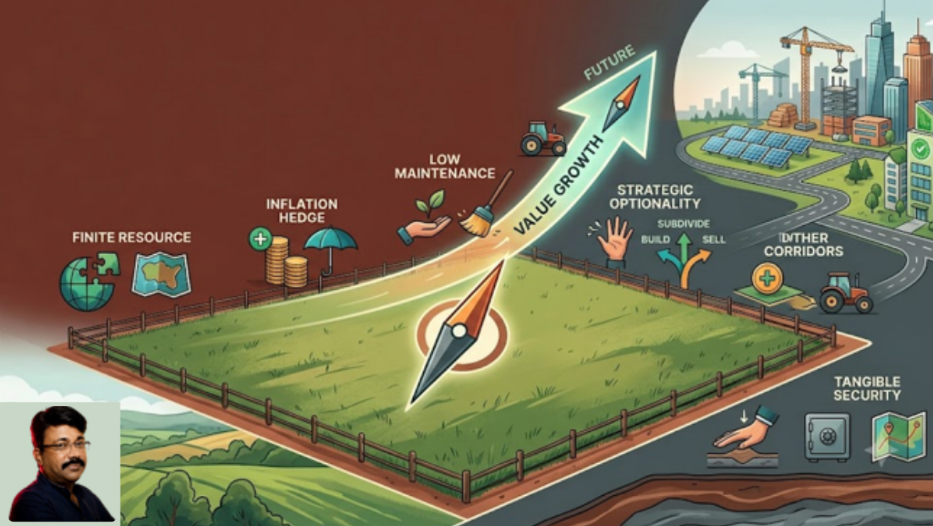
In an era characterized by digital asset volatility, macroeconomic shifts, and complex structured financial products, land, the world’s oldest asset class, remains at its most resilient. While physical improvements depreciate and technological paradigms shift, land remains the finite and irreplaceable foundation of all economic production.
When most people think of real estate investing, they mean buying houses, office buildings, and factory space and then renting them out to generate income. It is an undeniable truth that as development spreads from cities to villages as part of continuous urbanization, infrastructure expansion, and industrial restructuring, the value of the land you invested in yesterday increases tenfold. We have seen people become millionaires overnight in Noida, Gurugram, and the suburbs of Mumbai when the government and other agencies acquired land as part of urbanization.
You May AlsoLike This


Today’s new investment methods are all based on the stock market. Digital assets are often volatile. Investing in the volatile stock market offers few guarantees. In this context, the principle of ‘investing in land’, which is an age-old investment method in history, remains a reasonable and fundamental resource that underpins all economic activities.
Modern portfolio theory emphasizes diversification as a key risk management tool. Land often exhibits a low correlation with other major asset classes like stocks and bonds. This means that when the stock market is volatile or trending downward, land values might remain stable or even increase, helping to smooth out the overall returns of an investment portfolio.
Land is a physical asset you can see and touch. It offers a sense of security and long-term stability that digital assets often lack. : Adding land to your portfolio reduces reliance on a single asset class, mitigating overall risk.
The fundamental investment case for land rests on its total physical inelasticity. Unlike equities vulnerable to share dilution or fiat currencies subject to monetary expansion, the aggregate supply of land is finite, fixed, and impossible to replicate.
As demographic shifts drive urbanization and infrastructure outward, the competition for viable space accelerates. This structural convergence of inelastic supply and compounding demand applies persistent upward pressure on valuation. Positioning capital strategically in the path of growth corridors secures an irreplaceable spatial asset, effectively establishing a geographic monopoly positioned to capture long-term economic expansion.
For passive allocators, the principal friction point of built real estate lies in operational drag. Tenant vacancies, deferred structural maintenance, and third-party property management fees frequently erode net yields and convert an intended passive holding into an active management burden.
Raw land fundamentally resolves this operational friction by removing structural depreciation from the balance sheet. Unimproved land requires no physical maintenance, faces no tenant-induced deterioration, and incurs virtually zero capital expenditure (CapEx) liabilities. Ongoing holding costs are predominantly restricted to nominal property taxes and basic liability insurance. This capital-efficient carry model enables investors to navigate cyclical real estate downturns without liquidity pressure, maintaining a patient holding horizon until maximum valuation or strategic exit opportunities emerge.
Land has consistently demonstrated superior capital preservation characteristics during inflationary cycles. As a tangible hard asset with intrinsic utility, its valuation benchmarks closely against consumer price indices and broader replacement costs.
When monetary debasement erodes the purchasing power of fiat currency, real asset prices recalibrate upward. Because land serves as the foundational input for essential goods—including agriculture, natural resources, and residential shelter—it directly captures nominal macroeconomic expansion. This structural linkage ensures that well-positioned acreage preserves purchasing power in real terms, functioning as a durable vehicle for multi-generational wealth preservation.
Land functions as a proven capital preservation vehicle, offering structural protection against monetary debasement and stagflationary pressures. As consumer price indices rise and real purchasing power deteriorates, institutional capital consistently rotates into scarce, tangible real assets whose fundamental valuations adjust upward in tandem with macroeconomic inflation.
Because unimproved land carries no operational liabilities or structural depreciation, it provides a stable balance-sheet store of value—serving as a defensive, non-correlated haven that safeguards principal and preserves purchasing power through broader market contractions.
Acquiring completed residential stock—such as a built villa or apartment—confines capital to a rigid footprint, a predetermined layout, and a singular use case with limited scope for spatial reconfiguration. In contrast, plotted land functions as an unconstrained asset that confers complete strategic and design sovereignty to the investor.
This inherent adaptability enables capital allocators to dynamically pivot execution paths in response to changing micro-market demand.
You can build a custom luxury villa or retreat that matches the exact design and architectural specifications, avoiding developer finish compromises.
Non-interconnected operational yields can be generated through agroforestry, eco-tourism leases or commercial storage agreements.
It is also possible to obtain municipal layout approvals and sell them as smaller land parcels for profit. Raw land enables investors to synchronize ground-up development directly with macroeconomic expansion, capitalizing on peak cyclical demand across residential, commercial, or industrial sectors to maximize return on invested capital.
Unlike a stock certificate or a cryptocurrency, land is a physical, tangible asset. You can stand on it, fence it, and improve it. This physicality offers a profound psychological sense of security.
Furthermore, land cannot go bankrupt, be ‘hacked,’ or disappear overnight due to corporate mismanagement. While market values can fluctuate, the asset itself—the physical acreage—remains permanently in the investor’s possession.
Investing in land requires a slightly different mindset than buying a rental home; it is typically a game of patience and strategic foresight. Investing in land requires a shift from short-term income focus to long-term wealth accumulation. It lacks the immediate monthly cash flow of a tenant-occupied building, but compensates with unmatched security, absolute scarcity, minimal carrying costs, and immense upside potential. In a diversified portfolio, raw land stands out as a foundational asset that anchors wealth, waiting silently as the world grows around it.
So if you are willing to wait a little, it is best to invest in land. It will bring you profits- if not today, tomorrow- beyond your expectations.
By Viji K Varghese, Real Estate Expert, www.vijikvarghese.com