
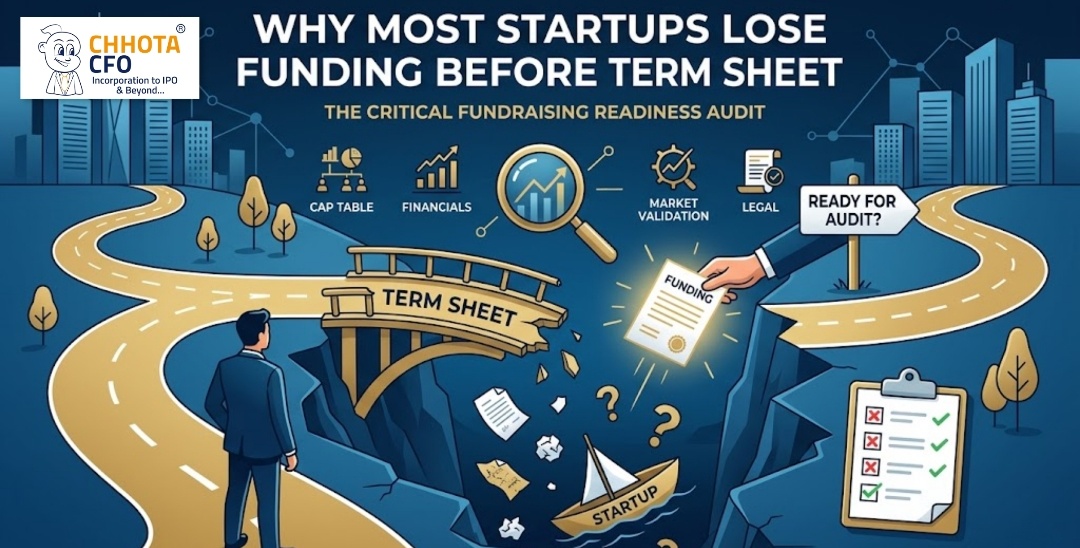
You built the product. Found your first customers. Started generating revenue. Now, you’re preparing for the fundraising round that could define the next chapter of your company’s growth.
Most founders assume that securing investment is all about perfecting the pitch deck, demonstrating market potential, and telling a compelling growth story. While these certainly matter, they are rarely what determines whether a deal ultimately closes.
You May AlsoLike This


The real test begins after investor interest arrives.
Before a term sheet is issued, investors conduct a far deeper assessment: one that has little to do with storytelling and everything to do with financial readiness. They examine your books, filings, governance practices, reporting systems, compliance records, and internal controls. In short, they audit your finance function and this is where many startups stumble.
Not because the business lacks potential, but because the financial infrastructure supporting that growth hasn’t evolved at the same pace as the company itself.
According to industry reports, more than half of investment deals encounter significant challenges during the due diligence stage, often due to gaps in documentation, compliance, governance, or financial reporting. What begins as a promising fundraising conversation can quickly turn into a prolonged diligence exerciseor worse, a missed opportunity.
A missing compliance filing. An outdated cap table. Unexplained founder transactions. Revenue recognition practices that don’t align with contracts. Individually, these may seem like small issues. Together, they create friction, delay diligence, weaken negotiating power, and in some cases, derail fundraising conversations entirely.Today’s investors are not simply investing in growth. They are investing in predictability, governance, and operational discipline.
The question every founder should ask before entering a fundraising process is simple:
“Is our finance function truly investor-grade?”
What Investors Actually Look For
One of the biggest misconceptions among founders is that investors primarily focus on revenue and growth metrics. While growth attracts attention, financial discipline determines confidence.
The first thing investors often evaluate is the quality of management reporting. A founder should be able to explain monthly performance through structured MIS reports that clearly outline revenue trends, cash position, burn rate, margins, and key business metrics. If financial data takes weeks to compile or changes every time it is reviewed, investors immediately question the company’s visibility into its own operations.
Revenue recognition is another critical area. Investors want confidence that reported growth accurately reflects business performance rather than accounting interpretation. Revenue booked inconsistently or recognised before services are delivered can quickly raise concerns during due diligence.
Ownership structures also come under close scrutiny. Investors expect a clean cap table that clearly documents founders, shareholders, ESOP pools, and share allotments. Missing records, undocumented commitments, or unresolved ownership disputes can significantly delay transactions and create unnecessary complexity during fundraising.
Related-party transactions often represent one of the biggest diligence concerns. Founders frequently use personal funds, transact with related entities, or engage vendors connected to family members during the early stages of growth. While common, these arrangements require complete transparency and proper documentation. Any unexplained transaction immediately raises questions about governance standards and financial controls.
Compliance history matters more than many founders realise. Delayed ROC filings, incomplete statutory records, or gaps in corporate documentation may appear administrative in nature, but investors view them as indicators of how seriously a company approaches governance.
Investors are equally interested in understanding the economics behind growth. Metrics such as Customer Acquisition Cost (CAC), Lifetime Value (LTV), gross margins, contribution margins, and payback periods help investors assess whether growth is sustainable. A founder who understands these numbers demonstrates control over the business. A founder who cannot explain them creates uncertainty.
Cash flow visibility has become another defining characteristic of investor-ready companies. Revenue may tell the story of growth, but cash tells the story of survival. Investors want clarity on burn rates, runway, working capital requirements, and future funding needs.
A credible financial model demonstrates how revenue targets, hiring plans, customer growth, and capital requirements connect to each other. Investors fund businesses with logic-driven plans, not optimistic spreadsheets.
The Founder Self-Assessment
Before approaching investors, founders should conduct a simple readiness audit.
- Can you produce your key financial and compliance documents within 48 hours?
- Are they accurate, up-to-date, and supported by proper documentation?
- Would you be comfortable sharing them with an investor today, without spending weeks cleaning them up first?
If the answer to any of these questions is no, there are gaps that need attention.
The objective is not perfection.
The objective is preparedness.
Where Most Founders Lose Valuable Time
In our experience, fundraising delays rarely occur because investors dislike the business. More often, they happen because founders underestimate the importance of financial readiness.
Weak MIS reporting slows diligence. Undocumented related-party transactions trigger deeper reviews. Incomplete compliance records require legal remediation. Financial projections without supporting assumptions reduce investor confidence.
Research from startup due diligence specialists suggests that inadequate financial documentation can delay fundraising processes by four to eight weeks and may even impact valuation discussions. In competitive fundraising environments, those delays can be costly.
The strongest fundraising processes are not necessarily driven by the most polished pitch decks. They are driven by businesses where the financial story, operational reality, and documentation all align.
Investor-Ready Doesn’t Mean Perfect
Many founders mistakenly believe they need to eliminate every issue before speaking to investors.That isn’t true.
Investors invest in companies with challenges every day. What differentiates successful fundraises is not the absence of gaps, but the founder’s ability to identify them early, address them systematically, and communicate transparently.
An investor-grade finance function is ultimately about credibility. It demonstrates that the company has the discipline to manage capital responsibly, scale sustainably, and navigate growth without losing control.
At Chhota CFO, we frequently work with founders at this exact inflection point. The difference between a smooth fundraising process and a prolonged diligence cycle often has little to do with the business opportunity itself. More often, it comes down to whether the finance function is prepared for institutional scrutiny.
Because when investors evaluate your company, they are not just assessing where you are today.They are assessing whether your business is ready for where it wants to go next.